Blog/ 2026-10-26
Crusher dust vs haul road dust: telling the two apart in a complaint investigation
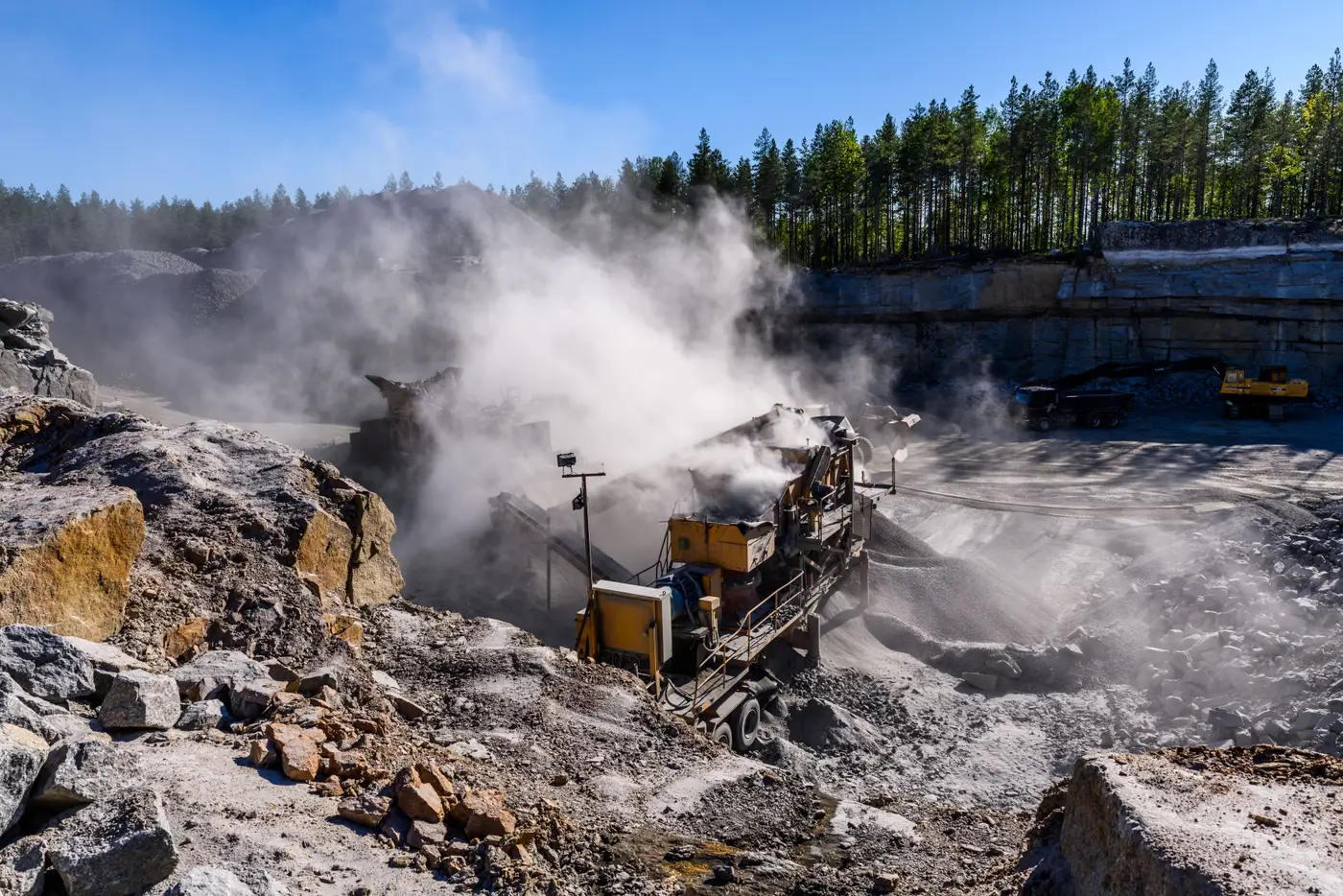
A complaint comes in. "Dust again, blowing off the mine toward the highway." That's the whole report, half the time. It doesn't say which stockpile, which shift, or whether it came off the crusher or a haul road three hundred meters away. And yet the suppression response, and the answer you give the regulator, depends entirely on getting that part right.
Treat the two sources as interchangeable and you end up watering a haul road that wasn't the problem while the crusher keeps throwing fines downwind. Here's what separates them when you're standing at the fence line trying to work out what happened.
How the two sources behave
Haul road dust is generated by moving equipment. It comes up in a trail behind the truck, settles along the road alignment, and tends to be coarser material, the stuff that drops out within a hundred meters or so unless wind picks it back up. Watch it long enough and the plume pattern tracks the haul schedule: heavier during shift changes and ore movement, quieter on a maintenance day when trucks are down.
Crusher dust comes off a fixed point. It's generated by the crushing and screening process itself, often with a finer particle fraction that carries further on wind. A crusher plume's shape is dictated by wind speed and direction at that single location. It tends to run during scheduled crushing hours and can persist as a visible haze around the plant even when no trucks are in sight.
The tell comes down to geometry and timing. A dust signature that follows a linear path matching the road centerline, moving and thinning as it goes, points to haul traffic. A dust signature that fans out from a fixed structure, independent of any vehicle in frame, points to the crusher or the stockpile beside it.
Why a ground observer's account usually isn't enough
Most complaint logs are built on one person's memory of one moment. A resident sees dust, calls it in, and the log gets a timestamp and a direction: "southwest of the property." That's enough to send someone out to look. It doesn't tell you the wind speed at the time, which unit was running, or where the plume boundary sat relative to the property line at that moment, and those are the three things a regulator will ask for if the complaint turns into an inspection.
Ground crew can walk the fence line after the fact and reconstruct a likely source from the wind log and the shift roster: which operations were running, what the wind was doing at the time. That reconstruction holds up fine until someone asks for the plume itself, which is exactly the gap that matters once a complaint escalates past a courtesy call.
What closes that gap is something that shows the plume itself at the moment it existed, tied to a location and an extent, not a reconstructed narrative. A marked-up image of the site at the time in question, with the plume boundary traced against the haul road and the crusher pad both, turns "probably the crusher" into something you can point to. Fugitive Dust Map was built around exactly that gap: request a pass after an event or complaint and get back an image with the plume segmented and a shapefile of its extent, so the source determination doesn't rest on one observer's account of which direction the dust came from.
Building the habit into your complaint response
If dust source identification at your mine is currently "ask the shift supervisor what was running," it's worth building a small checklist instead: what was the wind direction and speed at the time, which operations were active, and does the plume geometry match a road alignment or a fixed point. None of that requires new equipment on your end. It requires a record of the plume itself, captured close to the event, that you can lay over your site plan and read directly.
That record is also what turns a one-off defensive response into a targeting tool. Once you can see repeatedly that the crusher plume, not the haul road, is the one crossing the property line on a southwest wind, suppression spend stops being guesswork and starts going where the actual evidence says it belongs.