Blog/ 2026-10-14
What is a fenceline monitor, and why do mines install one?
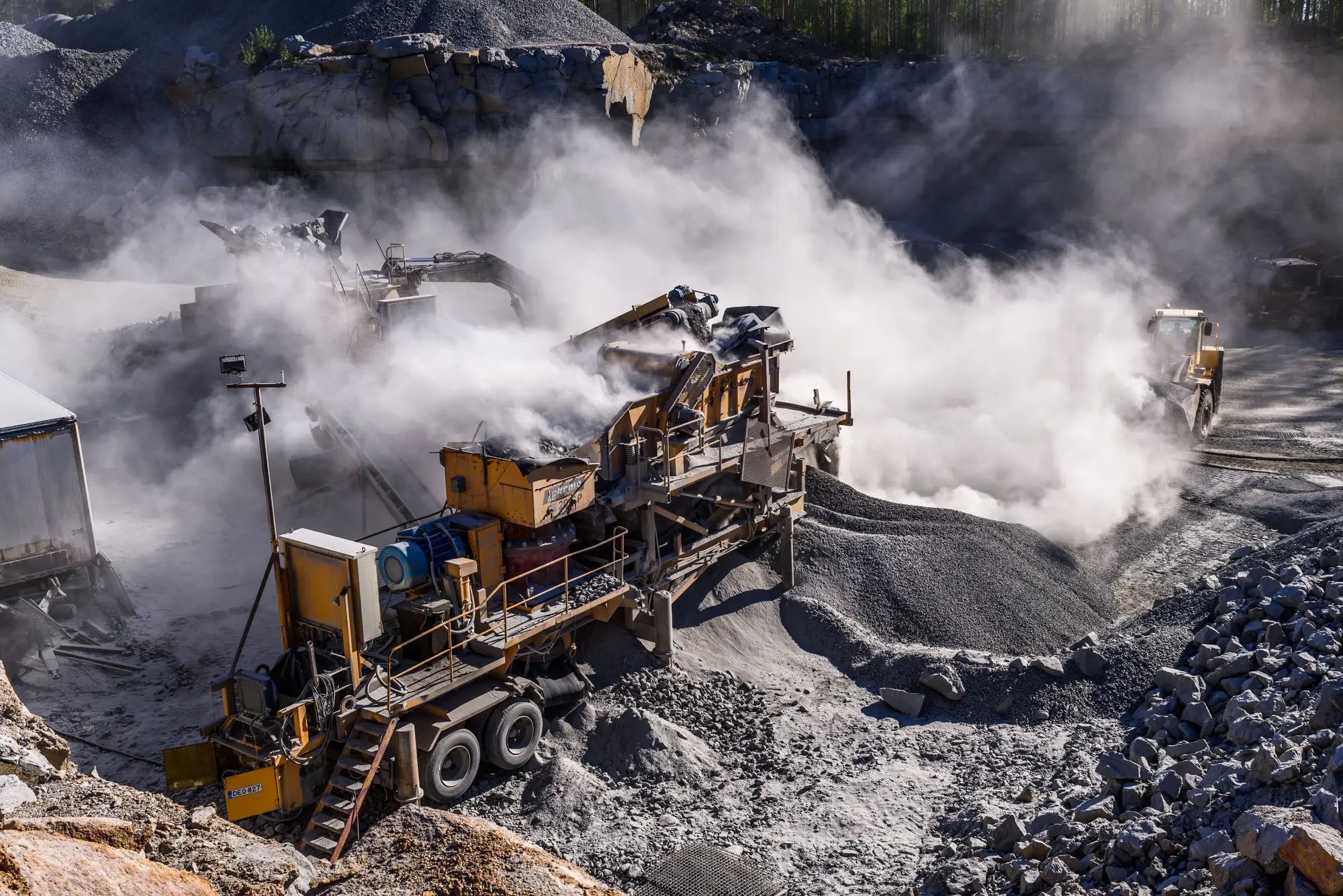
A fenceline monitor is a fixed instrument parked at the property boundary of a mine or quarry, sampling the air leaving the site rather than the air inside the pit or around the crusher. Most read PM10, some add PM2.5 or TSP, and they log continuously rather than on a schedule a tech sets. The name describes where the sampler sits rather than the technology inside it: the unit might be a tapered element oscillating microbalance, a beta attenuation monitor, or a simpler optical sensor, and it does its job at the property line, outside the pit or crusher area.
Mines install them for a few overlapping reasons. A permit condition is the most common: many states and several federal programs require continuous perimeter monitoring as a condition of operating, particularly near residential boundaries or sensitive receptors like schools. A second reason is defensive. Once a site has had a dust complaint land with the regulator, a fenceline station turns "we think it was fine that day" into a logged number a compliance officer can check against a threshold. A third reason shows up before expansion permitting, where an operator wants a baseline record showing ambient levels before a new pit or haul road goes in, so a future complaint can be weighed against pre-existing conditions rather than assumed to be new.
What the reading tells you
A fenceline monitor reports concentration at a single point on the property line. It can't tell you, by itself, which activity put that dust in the air. If the downwind station spikes at 2pm, you know PM10 crossed the fence at 2pm. Figuring out whether that came off the haul road, the crusher, an open stockpile, or a neighboring operation's tailings pond two properties over takes separate digging. Wind direction narrows the cone of possible sources, but on a site with multiple active areas lined up roughly downwind of each other, that cone can still cover half the pit.
This is why most sites with more than one monitor run two or three units: one upwind as background, one or more downwind near the likely source areas. More monitors narrow the guess. They still don't draw a line around which stockpile was uncovered or which section of haul road wasn't watered that shift. That gap shows up hardest during a complaint investigation, when a regulator or a neighbor asks where the dust came from and the honest answer is a number and a wind rose.
Fenceline data plus a source picture
A fenceline reading and a source-level picture answer different questions. The monitor tells a regulator that a threshold was or wasn't crossed. A record of which part of the site was generating visible dust that day is what lets an EHS team point water trucks and berm work at the source instead of blanket-treating the whole lease. Sites that only have the monitor end up relying on whoever happened to be driving past a stockpile or crusher that afternoon, which is thin evidence to put in front of a regulator or to budget suppression spend against.
A single satellite pass over the site on the day of an event can segment the dust plume itself back to its source area, handing back a marked-up image and a shapefile showing extent rather than a single downwind data point. Paired with the fenceline log, that turns "PM10 crossed 150 µg/m³ at 2pm" into "PM10 crossed 150 µg/m³ at 2pm, and here's the plume coming off the north stockpile at roughly that time." That's a materially different thing to hand a regulator than a log entry and a shrug.
Fenceline monitors stay part of the compliance picture because they're the instrument most permits actually name, with a specific averaging period and threshold written into the permit language. When the question after a complaint is where the dust came from, an answer that points at a location on the lease carries more weight than a number at the boundary. If that's the gap in your current setup, it's worth seeing what a marked-up plume image looks like against your own site.